Beyond Alarms and Cameras: How to Protect High-Value Collections at Home

Home security often begins at the perimeter. Better locks, cameras, alarms and motion sensors can make unauthorized entry more difficult, provide visibility around a property and alert homeowners when something is wrong.
But protecting a home and protecting the valuable possessions inside it are not exactly the same problem.
A house may contain jewelry, watches, important documents, collectibles or other possessions whose value is concentrated in a relatively small space. Once those possessions become sufficiently valuable, relying entirely on perimeter security leaves an important question unanswered: what protects the collection if the outer layers are not enough?
This is why home security is better considered in layers. Deterring unwanted access is one layer. Controlling entry is another. Detection and monitoring add another. For certain possessions, dedicated physical protection inside the home can provide an additional layer.
The right combination varies from one household to another, but security does not necessarily end at the front door.
High-Value Collections Present a Different Security Problem
A collection is different from an ordinary household possession for several reasons.
The first is concentrated value. Watches, jewelry, coins and other small collectibles can represent substantial financial value without occupying much physical space.
Collections are also constantly changing. New pieces are acquired, others may be sold, and individual items can leave the home temporarily for servicing, travel or other purposes.
Then there is everyday use.
Some pieces may be used frequently, while others remain stored for months. This means a collector needs more than somewhere hidden to put valuable objects. The storage also needs to make sense for the way the collection is actually used.
As collections grow, organization and security increasingly become connected.
A few watches or pieces of jewelry may be easy to manage in a box or drawer. A collection of twenty or thirty items creates different requirements. The owner needs to know what is stored, where individual pieces are located and how easily regularly used items can be accessed.
That is when dedicated secure storage can become part of the broader home-security plan.
Different Valuables Need Different Types of Protection
There is no single storage solution that is ideal for every valuable possession.
Important documents have different requirements from jewelry. A coin collection differs from a collection of mechanical watches. Larger collectibles introduce another set of practical considerations.
The storage should therefore reflect what it is intended to protect.
A conventional home safe may be entirely appropriate for documents, cash and general valuables. Specialized collections can introduce additional requirements beyond an empty secure compartment.
A watch collection is a good example.
Individual watches benefit from being kept apart so that cases, bracelets and clasps are not repeatedly contacting one another. Large sports watches may require considerably more room than smaller dress watches. Spare straps, bracelets and other accessories also accumulate as a collection grows.
Accessibility matters too. Someone who owns twenty watches may regularly rotate between only four or five. Those frequently used pieces need practical access, while other watches may remain stored for longer periods.
For collectors managing multiple high-value timepieces, purpose-built luxury watch safes can combine dedicated organization with an additional layer of physical protection.
The broader principle applies to any valuable collection: the internal configuration of secure storage should reflect the objects it is intended to hold.
Concealment and Physical Security Are Not the Same Thing
Keeping valuables out of obvious locations can be sensible, but hiding an object and physically protecting it serve different purposes.
A hidden drawer is still a drawer.
Dedicated secure storage creates a physical barrier around the possessions inside it. The appropriate type of storage depends on what is being protected, its value and the requirements of the household.
This distinction becomes more important as a collection grows.
The objective is not to place every valuable possession behind the strongest possible barrier. Instead, homeowners can consider which items justify an additional level of protection and how that protection fits with the other security measures already in place.
Cameras, for example, can provide visibility and records of activity. Alarms can provide alerts. Locks can restrict access. Secure storage addresses the physical protection of selected possessions.
These measures complement one another rather than performing the same job.
Good Security Still Has to Work in Everyday Life
Security can become counterproductive when it is so inconvenient that people stop using it consistently.
Frequently used valuables therefore need to remain practical to access.
Consider someone with a sizeable watch collection. The owner may wear four watches regularly while another fifteen are used only occasionally. An effective storage arrangement can recognize that difference rather than treating every item identically.
The same idea applies to jewelry and other personal collections.
This does not mean frequently used items need less protection. It means the organization of secure storage should reflect real habits.
The intended location matters for the same reason.
A safe or secure cabinet needs to work within the home rather than simply occupy whatever space happens to be available. With larger units, practical issues such as dimensions, weight, door access, stairs and elevators may need to be considered before installation.
These details are particularly important for substantial storage systems, which can be much more difficult to relocate than an ordinary box or cabinet.
Security works better when it is planned around the household instead of added without considering how people will actually use it.
Some Collections Have Specialized Storage Requirements
Certain collections introduce needs that general-purpose secure storage does not necessarily address.
Automatic watches are one example.
When an automatic watch remains unworn beyond its available power reserve, it will eventually stop. For many owners, this is not a problem; the watch can simply be wound and reset when it returns to use.
Collectors who rotate frequently between several automatic watches may prefer to keep selected pieces running. This is where watch winders can become relevant to storage.
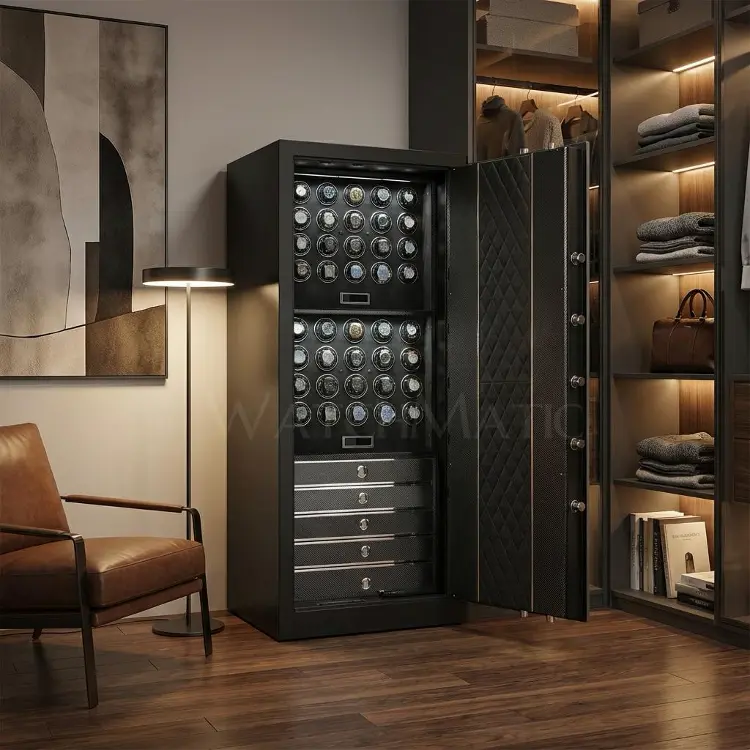
Winding, however, should not be confused with security.
A winder addresses the convenience of keeping selected automatic watches running. A safe addresses physical protection. Depending on the collection, the two functions can be separate or incorporated into the same storage environment.
Not every automatic watch needs to remain running, and not every collector needs winding functionality.
The point is broader than watches: specialized collections often have functional requirements that should be considered alongside security rather than after the storage has already been selected.
Documentation and Insurance Add Different Layers of Protection
A secure cabinet protects physical objects. It does not replace good records.
For higher-value collections, maintaining an inventory can make the collection considerably easier to manage. Depending on the objects involved, useful records may include photographs, purchase information, serial or reference numbers, valuations, warranty documents and service history.
These records do not necessarily need to be stored in the same place as the collection.
Original presentation boxes can also occupy surprisingly large amounts of space. Ten watch boxes, for example, may require considerably more storage than the ten watches they originally contained.
Insurance should be considered separately.
Coverage, valuation requirements and security conditions vary between insurers and policies, so owners should confirm what applies to their particular collection and circumstances rather than assuming that ordinary household coverage is sufficient.
Physical security, documentation and insurance address different risks.
A camera does not replace a safe. A safe does not replace an inventory. An inventory does not replace appropriate insurance.
Thinking in layers means understanding the role each measure actually performs.
Plan for the Collection You May Have Tomorrow
Collections rarely remain exactly the same size.
A cabinet designed for ten watches can appear generous when someone owns six. It becomes less generous when the eleventh arrives.
Future capacity is particularly worth considering with larger secure storage because replacing or relocating it can be considerably more complicated than buying another ordinary storage box.
The type of collection can change as well.
Someone who currently owns mostly smaller pieces may later acquire larger watches. A collection of simple mechanical watches may eventually include more pieces for which winding convenience becomes useful. Accessories and documentation also accumulate over time.
This does not mean choosing the largest possible safe.
Some spare capacity and a flexible internal arrangement can simply prevent the storage from becoming obsolete shortly after it is installed.
Security planning works best when it considers not only what is being protected today, but how those requirements might reasonably change.
Build Security Around What You Are Protecting
The larger and more valuable a collection becomes, the less useful it is to treat security, storage and organization as unrelated decisions.
The starting point should be the collection itself.
What needs the greatest protection? Which items are used regularly? Are there specialized storage requirements? How much capacity is needed? What records should be maintained? Does the insurance policy impose particular requirements?
For watch collectors, specialist storage brands such as WatchMatic approach these questions through systems designed specifically around timepieces, combining secure storage and organized interiors with automatic winding where appropriate.
Other types of collections will require different solutions.
What remains consistent is the principle: security should be selected around the objects being protected rather than assuming one product or technology can address every risk.
That also prevents a common mistake in home security — investing heavily in one layer while overlooking another.
Security Does Not Stop at the Front Door
Locks, cameras, alarms and monitoring systems remain important parts of protecting a home. They can deter, restrict and detect unauthorized access.
High-value possessions inside the home introduce another layer of responsibility.
For some households, that may mean dedicated secure storage. For others, it may also involve better documentation, updated insurance or reconsidering how valuable collections are organized and accessed.
There is no universal configuration that suits every property or every collection.
A stronger approach is to consider the layers individually: the home, access to it, detection of unusual activity, physical protection of selected possessions and the records and insurance that support them.
When those layers complement one another, home security becomes more than a collection of cameras, locks and alarms.
It becomes a system built around what actually needs protecting.
More to Read:




Previous Posts: